Roxane and Christian’s secret wedding ceremony
Cyrano de BergeracRoxane and Christian’s secret wedding ceremony turns an imposed marriage arrangement into a completed bond before Count de Guiche can intervene. In Roxane’s house, a friar is brought in to give the marriage benediction, while Roxane asks Cyrano to keep De Guiche at bay. The ceremony’s secrecy depends on that division of labor: the religious rite must be completed inside, and Cyrano must occupy the man who is expected to arrive.
The Order and Roxane’s Assent
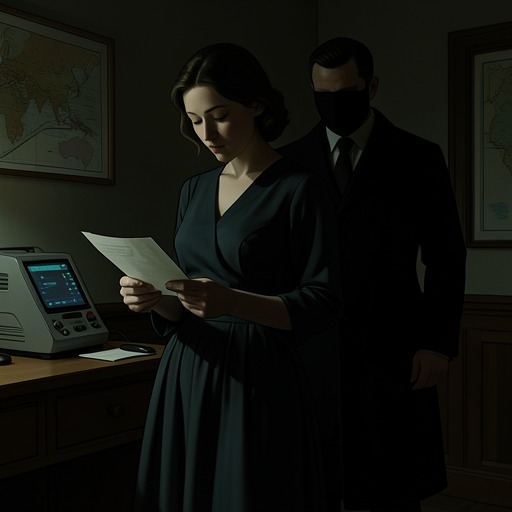
The scene begins with a letter read aloud in the presence of the friar and those gathered around Roxane. Its terms direct that the marriage benediction be given in her own house, that night, and without the knowledge of the wider world. It names Christian as the husband who will be sent to her, while acknowledging that he is abhorrent to her choice and telling her to resign herself to obedience. The arrangement is therefore presented not as the fulfillment of Roxane’s expressed preference but as an order she is expected to accept.
Roxane answers, “I submit!” The stage direction gives her a martyr’s look, making the gesture visibly different from a joyful declaration of consent. Yet she also acts within the narrow course available to her: as Ragueneau opens the door and Christian invites the friar inside, she turns to Cyrano and asks him to prevent De Guiche from reaching them. Her words reveal the immediate practical danger to the plan. The marriage has been arranged in secret, but its completion depends on keeping the person associated with the order away until the rite is finished.
The Ceremony in the House
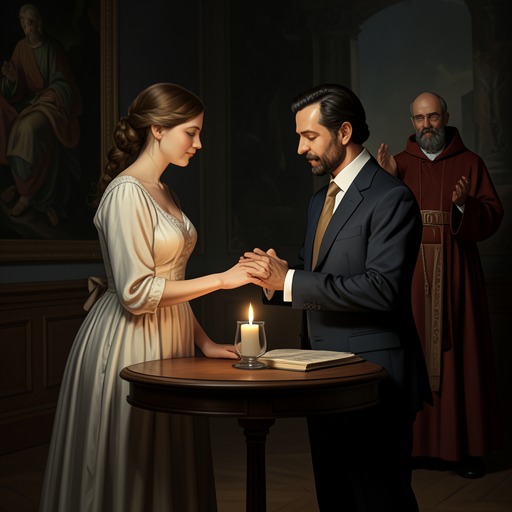
The ceremony is entrusted to a friar, whose presence supplies the religious authority needed to give the marriage its formal blessing. The setting is not a church but Roxane’s own house, as the letter expressly requires. That domestic location and the instruction that the marriage remain unknown to the world make the event both a religious rite and a private operation conducted under pressure.
Cyrano responds to Roxane’s request by asking the friar how much time he needs to tie the marriage-knot. The question makes the constraint concrete: the ceremony must fit within the interval Cyrano can secure outside. The text does not describe the vows at length; instead, it emphasizes the coordination surrounding them. Christian brings the friar in, Ragueneau opens the door, Roxane waits for the blessing to be performed, and Cyrano turns to delaying De Guiche. Each action serves the immediate purpose of completing the marriage before the interruption Roxane fears.
Cyrano’s Diversion and the Vows
Cyrano keeps De Guiche occupied in conversation. When the quarter has passed, he says that he will hinder him no more and announces that the marriage vows have been made. De Guiche springs up and asks who has married. Cyrano bows and identifies himself; he then explains that while the two men were chatting, Roxane and Christian had plighted troth. The exchange confirms the success of the diversion only after the ceremony is over: De Guiche learns the result when it can no longer be prevented in that moment.
Cyrano’s role is thus practical as well as personal. He does not perform the religious rite, but he creates the time in which the friar can perform it. Roxane’s request assigns him the task of holding De Guiche away; his later report makes clear that the marriage was completed during their conversation. The scene gives the ceremony a sharply divided structure, alternating the unseen progress of the vows with the delay outside. Secrecy here is not merely a condition stated in the letter; it is maintained by deliberate timing and Cyrano’s intervention.
Consequences and Significance
The decisive change is that Christian becomes Roxane’s husband through a benediction and vows carried out in her house, despite the letter’s acknowledgment that he is not the man she would choose. The scene sets the language of obedience beside the concrete accomplishment of a marriage: Roxane submits, the friar officiates, and Cyrano ensures that De Guiche arrives too late to interrupt the rite. Its secrecy is therefore both social and dramatic. The marriage is expressly to be unknown to the world, while the audience sees the concealment being made possible in real time.
The event also establishes a consequential contrast between formal authority and personal choice. The letter dictates the match and the friar gives it religious form, but Cyrano’s tactical diversion is what allows the ceremony to reach completion under the conditions imposed. The vows transform a threatened arrangement into an accomplished marriage, and De Guiche’s question afterward underscores how narrowly the outcome has been secured. The scene’s central action is not an extended exchange of vows but the successful passage through a brief, carefully guarded interval.